

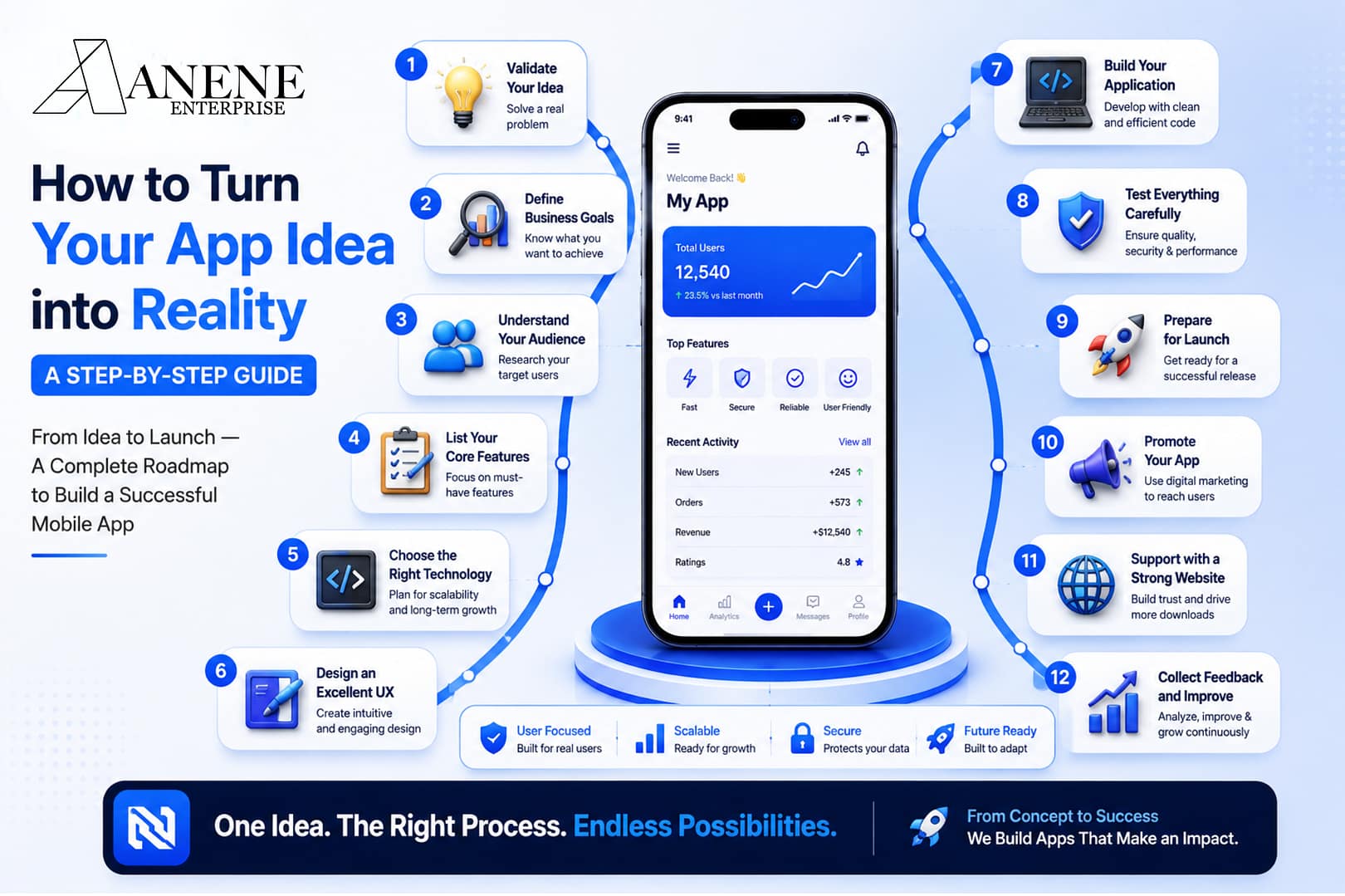
Every successful mobile application starts with a simple idea. Whether it’s solving a daily problem, improving customer service, or creating a new digital experience, every great app begins with a vision. However, turning that vision into a fully functional mobile application requires much more than a good idea.
Many businesses believe that once they have an app concept, the hardest part is over. In reality, the journey from idea to launch involves research, planning, design, development, testing, marketing, and continuous improvement.
At Anene Enterprise, we’ve helped businesses transform innovative ideas into practical digital solutions. We understand that every app has unique goals, target users, and business requirements. By following a structured process, businesses can reduce risks, control costs, and build applications that deliver real value.
In this guide, we’ll walk you through the complete process of turning your app idea into reality.
Step 1: Validate Your App Idea
Before investing time and money, make sure your idea solves a real problem.
Ask yourself:
- What problem does the app solve?
- Who will use it?
- Is there demand for this solution?
- What makes it different from competitors?
- Will people be willing to use or pay for it?
Conduct market research by analyzing competitors, reading customer reviews, and speaking with potential users.
Validation helps ensure that you’re building something people actually need.
Step 2: Define Your Business Goals
Every successful app should support a clear business objective.
Your goal may be to:
- Increase sales
- Improve customer service
- Automate business operations
- Generate subscriptions
- Build customer loyalty
- Expand into new markets
Clearly defining these objectives helps guide every decision throughout the project.
Without measurable goals, it becomes difficult to evaluate success.
Step 3: Understand Your Target Audience
Your application should be designed around the people who will actually use it.
Research your audience by considering:
- Age
- Interests
- Profession
- Technical experience
- Shopping behavior
- Preferred devices
- Common challenges
Understanding your users allows you to prioritize the features that matter most.
A customer-focused product is far more likely to succeed than one built on assumptions.
Step 4: List Your Core Features
One common mistake is trying to build everything at once.
Instead, identify the essential features required for your first release.
Examples include:
- User registration
- Login
- Search
- Notifications
- Booking system
- Online payments
- Customer profile
- Reviews
- Messaging
- Order tracking
Avoid unnecessary complexity during the initial launch.
Additional features can always be introduced after collecting user feedback.
This approach reduces both development time and overall project costs.
Step 5: Choose the Right Technology
Selecting the right technology is one of the most important decisions in the entire project.
During App Development, businesses should think beyond immediate requirements and consider future growth.
Important factors include:
- Scalability
- Performance
- Security
- Maintenance
- Integration
- Platform compatibility
Whether you build for Android, iOS, or both, your technology choices should support long-term business goals.
Step 6: Design an Excellent User Experience
A successful application is easy to understand and enjoyable to use.
This is where UI/UX Design becomes essential.
Good design helps users:
- Find information quickly
- Complete tasks easily
- Navigate without confusion
- Build confidence in your brand
Your application should use:
- Simple navigation
- Clear layouts
- Readable typography
- Consistent colors
- Logical user flows
- Fast interactions
Excellent design increases customer satisfaction while encouraging repeat usage.
Step 7: Build Your Application
Once planning and design are complete, development begins.
Professional App Development involves much more than writing code.
Developers work on:
- Front-end functionality
- Back-end systems
- APIs
- Databases
- Authentication
- Notifications
- Payment gateways
- Security
Communication between developers, designers, and business stakeholders is important throughout this stage.
Regular testing and progress reviews help keep the project on schedule.
Step 8: Test Everything Carefully
Testing is one of the most important stages of the project.
Before launch, your application should be tested for:
- Functionality
- Performance
- Security
- Device compatibility
- Navigation
- User experience
- Payment systems
- Error handling
Testing should involve both internal teams and real users.
Their feedback often identifies improvements that developers may overlook.
Launching a stable application creates a stronger first impression.
Step 9: Prepare for Launch
Launching an app requires more than simply publishing it to an app store.
Businesses should prepare:
- Screenshots
- App descriptions
- Promotional videos
- Branding materials
- Support documentation
- Privacy policy
- Marketing assets
A well-planned launch increases visibility and improves the chances of attracting early users.
Step 10: Promote Your App
Even an excellent application cannot succeed if nobody knows about it.
This is where Digital Marketing becomes essential.
Effective promotion may include:
- Search Engine Optimization
- Social media campaigns
- Content marketing
- Paid advertising
- Email marketing
- Influencer partnerships
- Referral campaigns
Marketing should begin before launch and continue afterward.
Consistent promotion helps attract new users while increasing brand awareness.
Step 11: Support Your App with a Strong Website
Your website remains an important part of your digital presence.
Many customers first discover businesses through search engines before downloading an app.
Professional Web Development ensures your website:
- Loads quickly
- Works on all devices
- Explains your services
- Encourages app downloads
- Builds trust
- Supports SEO
Your website and application should work together to create a seamless customer experience.
Step 12: Collect Feedback and Improve
Your first version is only the beginning.
After launch:
- Monitor analytics
- Read customer reviews
- Respond to feedback
- Fix bugs
- Improve performance
- Introduce new features
Continuous improvement keeps your application competitive while increasing customer satisfaction.
The most successful apps evolve over time based on real user needs.
Related Reading: Start with the Right Foundation
Before beginning the development process, businesses should first understand the key decisions that influence an app’s success.
In our previous blog, “Android, iOS, or Cross-Platform App: Which One Should You Choose?,” we explained why defining your goals, understanding your audience, selecting the right features, planning your budget, and preparing for long-term growth are essential before writing a single line of code.
That article serves as the perfect starting point, while this guide explains what happens after those important decisions have been made. Together, the two guides provide a complete roadmap from planning your app to successfully launching it.
Why Choose Anene Enterprise?
Building an application is about more than technology it’s about creating a solution that delivers measurable business value.
At Anene Enterprise, we guide businesses through every stage of the development journey, from idea validation and planning to design, development, testing, deployment, and ongoing support.
Our team focuses on creating secure, scalable, and user-friendly applications tailored to each client’s goals. Rather than offering generic solutions, we build digital products that solve real business challenges and support long-term growth.
Whether you’re launching a startup, modernizing an existing business, or expanding your digital services, our approach is designed to help you move from concept to success with confidence.
Final Thoughts
Every successful mobile application begins with a great idea but success depends on the process that follows.
By validating your concept, understanding your audience, planning carefully, choosing the right technology, investing in quality design, testing thoroughly, and promoting your application effectively, you can significantly improve your chances of building a successful product.
A mobile app should not simply exist it should solve problems, create value, and help your business grow.
With the right strategy, experienced guidance, and a commitment to continuous improvement, your idea can become a powerful digital solution that serves customers for years to come.
At Anene Enterprise, we’re passionate about helping businesses transform innovative ideas into high-quality mobile applications that make a real impact.
The journey starts with one idea. The next step is turning it into reality.