

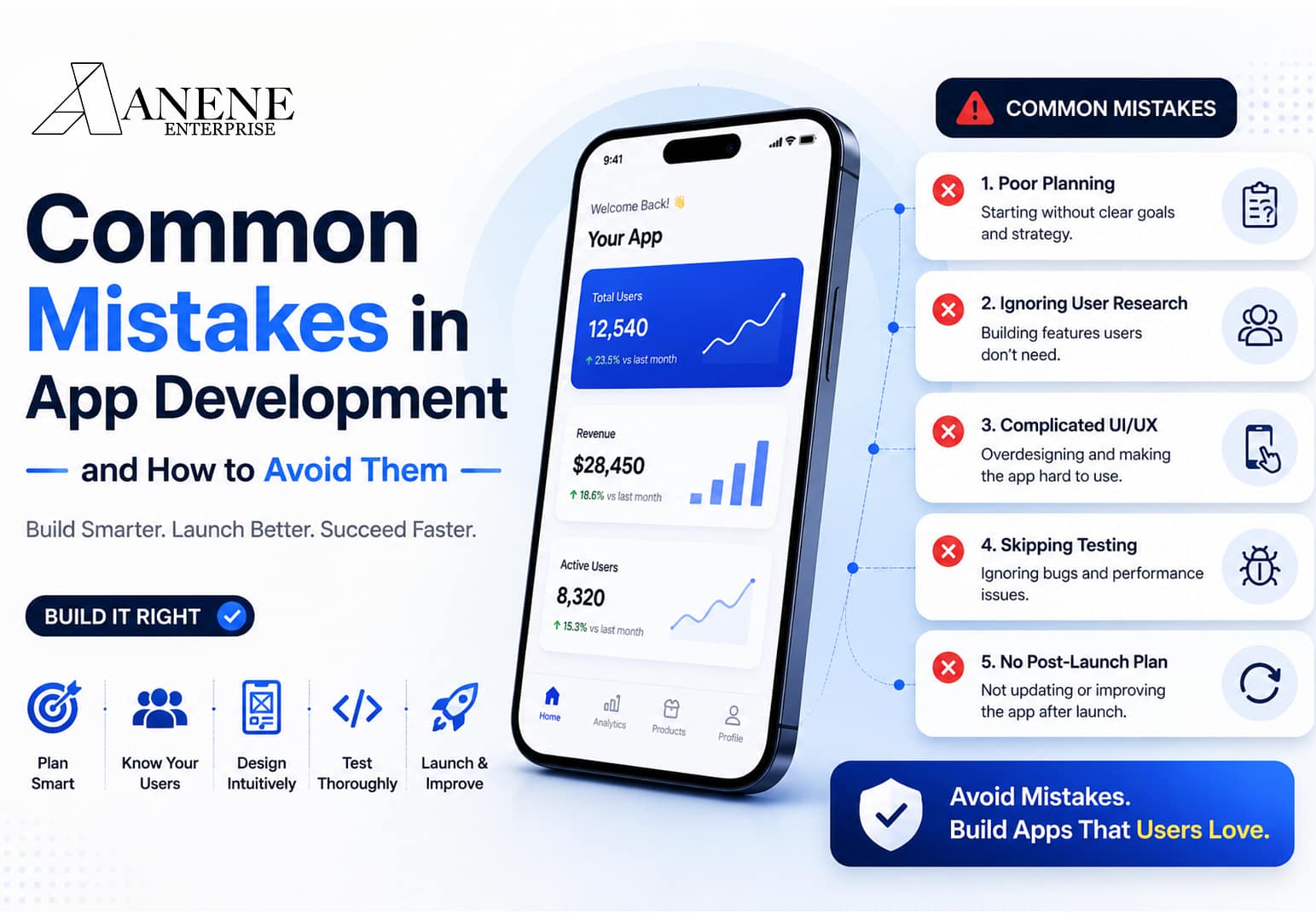
Building a mobile application can be an exciting opportunity for any business. A successful app can help companies connect with customers, improve their services, simplify operations, increase engagement, and create new revenue opportunities.
However, developing an app is not as simple as having an idea and turning it into code.
Many businesses make avoidable mistakes during the planning, design, development, and launch stages. Some focus too much on features, while others ignore their target audience. Some invest heavily in development but don’t have a marketing strategy after launch.
These mistakes can increase costs, delay the project, reduce user satisfaction, and sometimes cause an otherwise great app to fail.
At Anene Enterprise, we believe that successful applications begin with proper planning and a clear understanding of business goals. Before starting development, businesses should understand the most common mistakes and take steps to avoid them.
In this guide, we’ll explore the most common mistakes businesses make during app development and explain how to build a stronger foundation for long-term success.
1. Starting Development Without a Clear Goal
One of the biggest mistakes businesses make is starting development before deciding exactly what the application should achieve.
Having an app idea is not enough.
You need to understand:
- What problem will the app solve?
- Who will use it?
- What value will it provide?
- What business goal will it support?
- How will success be measured?
Without clear answers, the project can quickly become complicated.
Developers may receive changing requirements, unnecessary features may be added, and the final product may not solve the original problem.
Before development begins, create a clear project plan that defines the purpose, target audience, core features, and expected outcomes.
2. Trying to Build Too Many Features
Another common mistake is trying to include every possible feature in the first version of an app.
Businesses often think that adding more features will make their application more valuable. In reality, too many features can make an app confusing and difficult to use.
Extra features can also increase:
- Development costs
- Development time
- Testing requirements
- Maintenance expenses
- User confusion
Instead of building everything at once, focus on the most important features.
Start with a Minimum Viable Product (MVP) that solves the main customer problem. Once users begin interacting with the application, you can collect feedback and introduce additional features based on actual demand.
A focused product is often more effective than an overloaded one.
3. Ignoring the Target Audience
Your application is being built for users not for the development team.
Yet many businesses make decisions based on what they personally like instead of what their customers actually need.
Before beginning development, research your target audience.
Consider:
- Their age
- Location
- Interests
- Buying behavior
- Technical experience
- Common problems
- Preferred devices
For example, an application designed for young users may require a very different experience from an app created for professional business users.
Understanding your audience allows you to create features and experiences that are relevant to the people who will actually use the application.
4. Choosing Technology Without Considering the Future
Technology decisions shouldn’t only focus on today’s requirements.
Businesses should also think about future growth.
Your application may start with a few hundred users, but what happens if it eventually reaches thousands or millions?
A poorly planned technical structure can make scaling difficult and expensive.
During App Development, businesses should consider:
- Performance
- Security
- Scalability
- Maintenance
- Integration requirements
- Future feature development
The technology stack should support both current needs and future business goals.
A scalable foundation makes it easier to improve the application as the business grows.
5. Neglecting UI/UX Design
A powerful application can still fail if users don’t enjoy using it.
This is why UI/UX Design should never be treated as an afterthought.
Poor design can result in:
- Confusing navigation
- Difficult checkout processes
- Unclear buttons
- Poor readability
- Inconsistent layouts
- Frustrating user experiences
Good design should make the application feel natural and easy to use.
Users should be able to understand what to do without needing instructions for every step.
A clean interface, logical navigation, consistent branding, and simple interactions can make a major difference in customer satisfaction.
6. Building an App Without a Strong User Journey
Businesses sometimes focus heavily on individual screens but forget to think about the complete customer journey.
A user may discover your app through an advertisement, download it, create an account, browse products, add something to a cart, make a payment, and receive confirmation.
Every stage should feel connected.
If users face unnecessary obstacles during any part of this journey, they may leave before completing their intended action.
Map out the customer journey before development begins.
Think about every step from the first interaction to the final conversion.
The smoother the journey, the better the opportunity for engagement and sales.
7. Ignoring Performance and Loading Speed
Nobody likes a slow application.
Users expect apps to open quickly and respond smoothly to their actions.
If an application takes too long to load, freezes frequently, or crashes, users may uninstall it.
Performance should therefore be considered from the beginning rather than being treated as a problem to solve after launch.
Developers should optimize:
- Images
- Database queries
- API requests
- Code
- App size
- Server performance
Regular performance testing can identify problems before they affect real customers.
A fast application creates a better experience and improves the chances of users staying engaged.
8. Not Testing the App Properly
Launching an application without sufficient testing is a serious mistake.
Even a small bug can create a poor impression of your business.
Testing should cover different areas, including:
- Functionality
- Security
- Performance
- Compatibility
- Navigation
- Payments
- Notifications
- Different screen sizes
The app should also be tested on different devices and operating systems where applicable.
Real users can discover problems that developers may not notice during internal testing.
That’s why testing should be treated as an ongoing part of the development process.
9. Forgetting About Security
Security is especially important when an application handles personal information, payments, customer accounts, or business data.
Weak security can lead to serious consequences for both the business and its customers.
Businesses should consider:
- Secure authentication
- Data protection
- Safe payment processing
- Access control
- Secure APIs
- Regular security updates
Customers need to trust your application before they are willing to share information or make purchases.
Security should therefore be built into the application from the beginning rather than added later.
10. Not Planning for App Maintenance
Some businesses think the project is finished once the app is published.
It isn’t.
After launch, applications need ongoing maintenance and improvement.
Operating systems change, devices evolve, security threats develop, and users expect new features.
Regular maintenance may include:
- Bug fixes
- Security updates
- Performance improvements
- Compatibility updates
- New features
- User experience improvements
A long-term maintenance strategy keeps your application reliable and relevant.
11. Building an App Without a Marketing Strategy
Creating a great application doesn’t automatically guarantee downloads.
People need to discover it.
This is where Digital Marketing becomes important.
Businesses can promote their applications through:
- Search Engine Optimization
- Social media campaigns
- Paid advertising
- Content marketing
- Email marketing
- Influencer campaigns
- Referral programs
Your marketing strategy should ideally begin before launch.
Building anticipation, creating awareness, and preparing promotional content can help generate interest when the app becomes available.
After launch, analytics can be used to identify which marketing channels are bringing the most valuable users.
12. Ignoring Your Website
Your app and website should support each other.
A website is often where potential customers first discover a company through search engines, advertisements, or social media.
A professional website can explain your services, showcase your application, provide useful information, and direct users toward downloading the app.
That’s why Web Development remains an important part of a complete digital strategy.
Your website should be fast, mobile-friendly, easy to navigate, and consistent with your app’s branding.
When both platforms work together, customers receive a more connected experience.
13. Not Listening to User Feedback
Your customers can tell you things that analytics alone cannot.
After launch, encourage users to share their opinions.
Ask them:
- What do they like?
- What frustrates them?
- Which features are missing?
- What would make the app easier to use?
- What problems are they experiencing?
Reviews, surveys, support requests, and user interviews can provide valuable information.
Use that feedback to prioritize future updates.
An application should evolve based on real customer needs rather than remaining exactly the same after launch.
What We Discussed in Our Previous Blog
Before starting an application project, it’s important to understand the decisions that need to be made before development begins.
In our previous blog, 5 Things to Decide Before Building Your App, we discussed five important areas businesses should consider before starting their project.
Those include:
- Defining the purpose of the application
- Understanding the target audience
- Choosing the right features
- Planning the budget and timeline
- Thinking about long-term growth
These decisions provide a strong starting point for the development process.
Once those foundations are clear, businesses can focus on avoiding the common mistakes discussed in this article.
Together, both guides provide a useful roadmap for businesses that are considering building their first application or improving an existing one.
How Anene Enterprise Helps Businesses Avoid These Mistakes
Choosing an experienced technology partner can make the development process significantly easier.
At Anene Enterprise, we believe that every application should begin with strategy.
Our process focuses on understanding the business, customers, goals, and challenges before moving into development.
We consider the complete digital experience from planning and design to development, testing, launch, marketing, and future improvements.
Our approach can help businesses avoid unnecessary features, confusing interfaces, weak planning, poor performance, and other common problems that can negatively affect an application’s success.
We also understand that every business is different.
A booking platform, e-commerce application, healthcare solution, educational platform, and business management app will have completely different requirements.
That’s why we focus on creating solutions based on specific business needs rather than following a one-size-fits-all approach.
Final Thoughts
Building a mobile application can create exciting opportunities for your business, but success depends on more than simply having a good idea.
Poor planning, unnecessary features, weak design, inadequate testing, security issues, slow performance, and a lack of marketing can all prevent an application from reaching its full potential.
The best way to avoid these problems is to plan carefully before development begins and continue improving after launch.
Your app should be built around real customer needs, supported by reliable technology, and designed to grow alongside your business.
With the right strategy and experienced guidance, you can turn your idea into a digital product that provides genuine value to your customers.
At Anene Enterprise, our goal is to help businesses make smarter digital decisions and create solutions that support long-term growth.
If you’re planning your next application, don’t just ask, “Can we build it?”
Ask the more important question:
“How can we build it the right way?”