

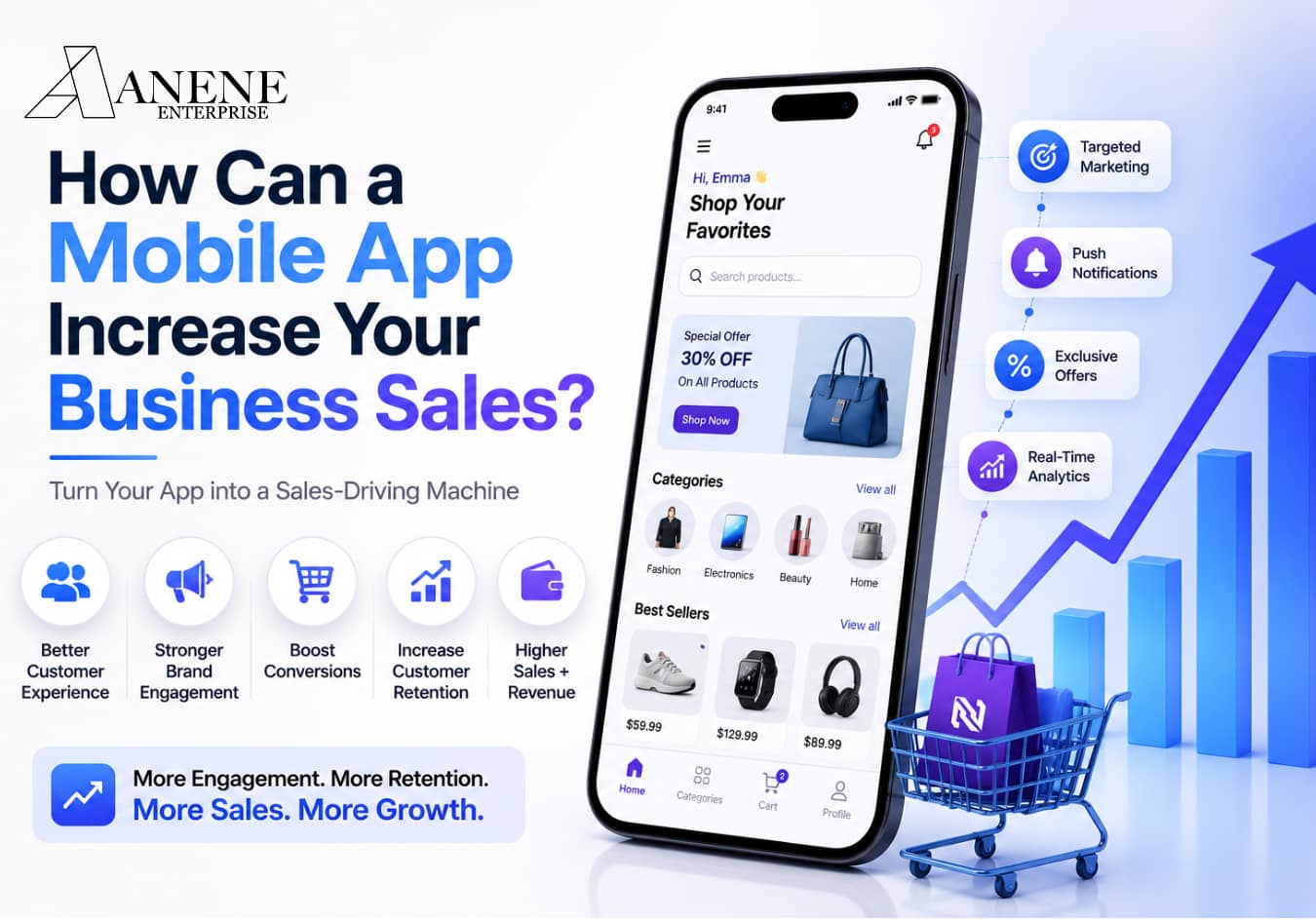
In today’s competitive digital market, businesses are constantly looking for better ways to attract customers, increase engagement, and generate more sales. While websites and social media remain important, a mobile app can take your customer experience to another level.
A mobile application gives your business a direct connection with customers through their smartphones. It allows people to explore products, book services, place orders, receive offers, make payments, and interact with your brand whenever they want.
At Anene Enterprise, we help businesses understand how technology can support real business growth. A well-planned mobile app is not simply another digital product—it can become a powerful sales channel that makes it easier for customers to discover, trust, and purchase from your business.
But how exactly can a mobile app increase sales?
Let’s explore the key ways.
1. Make It Easier for Customers to Buy
One of the biggest advantages of having a mobile app is convenience.
Customers don’t want complicated buying processes. If they have to visit multiple pages, fill out lengthy forms, or search through confusing menus, they may leave before completing a purchase.
A well-designed application can simplify the customer journey.
For example, an app can allow customers to:
- Browse products or services
- Add items to a cart
- Save favorite products
- Book appointments
- Make online payments
- Track orders
- Receive confirmations
- Contact customer support
The fewer steps customers need to take, the easier it becomes to convert interest into an actual sale.
This is why App Development should focus not only on technical functionality but also on creating a smooth purchasing experience.
2. Build Direct Relationships With Customers
Social media platforms are useful, but businesses don’t fully control how or when their content reaches followers.
A mobile app gives your business a more direct communication channel.
Customers who download your app have already shown interest in your brand. This creates an opportunity to build stronger relationships and encourage repeat purchases.
Through your application, you can provide:
- Personalized offers
- New product announcements
- Special discounts
- Order updates
- Appointment reminders
- Loyalty rewards
- Important business notifications
A customer who regularly interacts with your brand is more likely to remember your business when they are ready to make another purchase.
3. Use Push Notifications to Increase Sales
Push notifications can be an effective way to bring customers back to your business.
For example, imagine someone adds a product to their cart but doesn’t complete the purchase. Your app can send a reminder later.
Similarly, you can notify customers about:
- Limited-time offers
- New arrivals
- Seasonal promotions
- Flash sales
- Discount codes
- Restocked products
- Upcoming appointments
However, notifications should be used carefully. Sending too many irrelevant messages can frustrate customers.
The goal should be to send useful, timely, and relevant information that encourages customers to return.
4. Create Personalized Customer Experiences
Customers appreciate businesses that understand their interests.
A mobile app can collect useful information about customer behavior, such as the products they view, services they book, or categories they frequently explore.
With the right strategy, businesses can use this information to provide more personalized experiences.
For example, an online store could recommend products based on previous purchases. A salon could remind customers when it’s time for another appointment. A restaurant could highlight meals based on previous orders.
Personalization can make customers feel valued while increasing the possibility of additional purchases.
5. Increase Customer Loyalty
Getting a new customer is important, but keeping existing customers can be even more valuable for long-term growth.
A mobile app can help businesses create loyalty programs that encourage customers to return.
You could offer:
- Reward points
- Exclusive discounts
- Membership benefits
- Referral rewards
- Birthday offers
- Repeat-purchase incentives
For example, customers could receive points every time they make a purchase and redeem those points for discounts later.
These types of incentives encourage repeat business and can turn occasional customers into loyal customers.
6. Make Your Brand More Accessible
Customers carry their smartphones everywhere.
When your business has a mobile application installed on their device, your brand can remain easily accessible.
Instead of searching Google every time customers need your product or service, they can simply open your application.
This creates a convenient experience while keeping your brand closer to the customer.
A professional app can also strengthen your brand identity by maintaining consistent colors, typography, messaging, and visual elements across the entire experience.
7. Improve the User Experience
A mobile app can increase sales only when customers enjoy using it.
If the application is slow, confusing, difficult to navigate, or visually outdated, customers may uninstall it.
That’s why UI/UX Design is such an important part of a successful mobile application.
A good interface should make it easy for users to understand where they are and what they should do next.
Important design elements include:
- Clear navigation
- Simple layouts
- Easy-to-find buttons
- Fast interactions
- Readable text
- Consistent branding
- Simple checkout processes
The goal is not to add as many design elements as possible. The goal is to make every interaction simple and useful.
8. Support Your Website With Your Mobile App
A mobile app doesn’t have to replace your website.
Instead, both platforms can work together.
Your website can help customers discover your business through search engines, learn about your services, read information, and find contact details.
Your app can then provide a more personalized experience for existing customers.
This combination can create a stronger digital ecosystem.
Professional Web Development also plays an important role because your website should provide a consistent experience with your application.
When customers see the same brand identity across your website and app, it becomes easier to build trust and recognition.
9. Reach Customers Through Digital Marketing
Creating an app is only one part of the process. Customers need to know that your application exists.
This is where Digital Marketing can help.
Businesses can promote their apps through:
- Search engine optimization
- Social media campaigns
- Paid advertising
- Email marketing
- Content marketing
- Influencer marketing
- Referral campaigns
For example, you can create social media campaigns encouraging customers to download the app and receive an exclusive discount.
You can also use content to explain the benefits of using your app and show customers how it makes their lives easier.
The more effectively you promote your application, the more opportunities you create to acquire new users.
10. Offer Exclusive Deals Through Your App
One effective way to encourage app downloads is by giving customers something they cannot get elsewhere.
Businesses can offer app-exclusive:
- Discounts
- Coupons
- Early access
- Special packages
- Loyalty rewards
- Free delivery
- Limited-time promotions
For example, an online store could offer 10% off the first purchase made through its app.
A restaurant could provide a special meal deal exclusively to app users.
These offers give customers a clear reason to download the application and make their first purchase.
11. Make Payments Faster and Easier
A complicated payment process can cause customers to abandon their purchase.
Mobile applications can integrate secure payment options that make transactions faster and more convenient.
Depending on the business model, an application may support:
- Credit and debit cards
- Digital wallets
- Online banking
- Cash-on-delivery options
- Subscription payments
The more convenient the payment process is, the easier it becomes for customers to complete their orders.
Businesses should also prioritize security and transparency so customers feel confident when making transactions.
12. Understand Customer Behavior Through Analytics
One major advantage of digital platforms is the ability to measure customer activity.
Businesses can analyze information such as:
- Number of active users
- Most viewed products
- Most popular services
- Purchase frequency
- Cart abandonment
- Customer retention
- Conversion rates
These insights help businesses understand what is working and what needs improvement.
Instead of making decisions based purely on assumptions, you can use real customer behavior to improve your products, marketing campaigns, and sales strategy.
13. Create Opportunities for Repeat Purchases
A mobile application can help businesses stay connected with customers after their first purchase.
For example, an e-commerce business can recommend related products.
A service provider can remind customers when it’s time to book again.
A subscription-based business can provide renewal reminders.
These small interactions can create additional sales opportunities without requiring customers to discover your business from scratch every time.
Repeat purchases can become an important part of sustainable revenue growth.
14. Why the Right Technology Partner Matters
A mobile app is an investment, so choosing the right development partner is important.
At Anene Enterprise, we believe every successful app begins with a clear understanding of the business, target audience, and customer journey.
Our approach focuses on building digital experiences that are practical, scalable, user-friendly, and aligned with business goals.
From the initial idea to design, development, testing, launch, and future improvements, every stage needs careful planning.
We don’t believe that every business needs the same type of application. The right solution depends on your customers, industry, business model, and long-term objectives.
What Makes a Mobile App Successful?
Simply having an app doesn’t guarantee higher sales.
The application needs to provide real value.
A successful business app should be:
- Easy to use
- Fast and reliable
- Secure
- Mobile-friendly
- Visually appealing
- Simple to navigate
- Regularly updated
- Connected to your business goals
It should solve a real customer problem while making it easier for people to interact with your brand.
That’s where strategic App Development becomes important. The technology should support the business instead of becoming an unnecessary complication.
Final Thoughts
A mobile app can become much more than a platform for selling products or services. It can create a direct connection between your business and customers while improving convenience, engagement, loyalty, and repeat purchases.
From personalized recommendations and push notifications to loyalty programs, easy payments, exclusive offers, and customer analytics, a well-planned application can create multiple opportunities for increasing sales.
However, success depends on more than simply launching an app. You need a clear strategy, excellent user experience, reliable technology, and consistent promotion.
At Anene Enterprise, we help businesses turn digital ideas into practical solutions designed to support long-term growth. Whether you’re starting with a new app idea or looking to improve an existing digital presence, the right strategy can help you turn more visitors into customers and more customers into loyal buyers.