

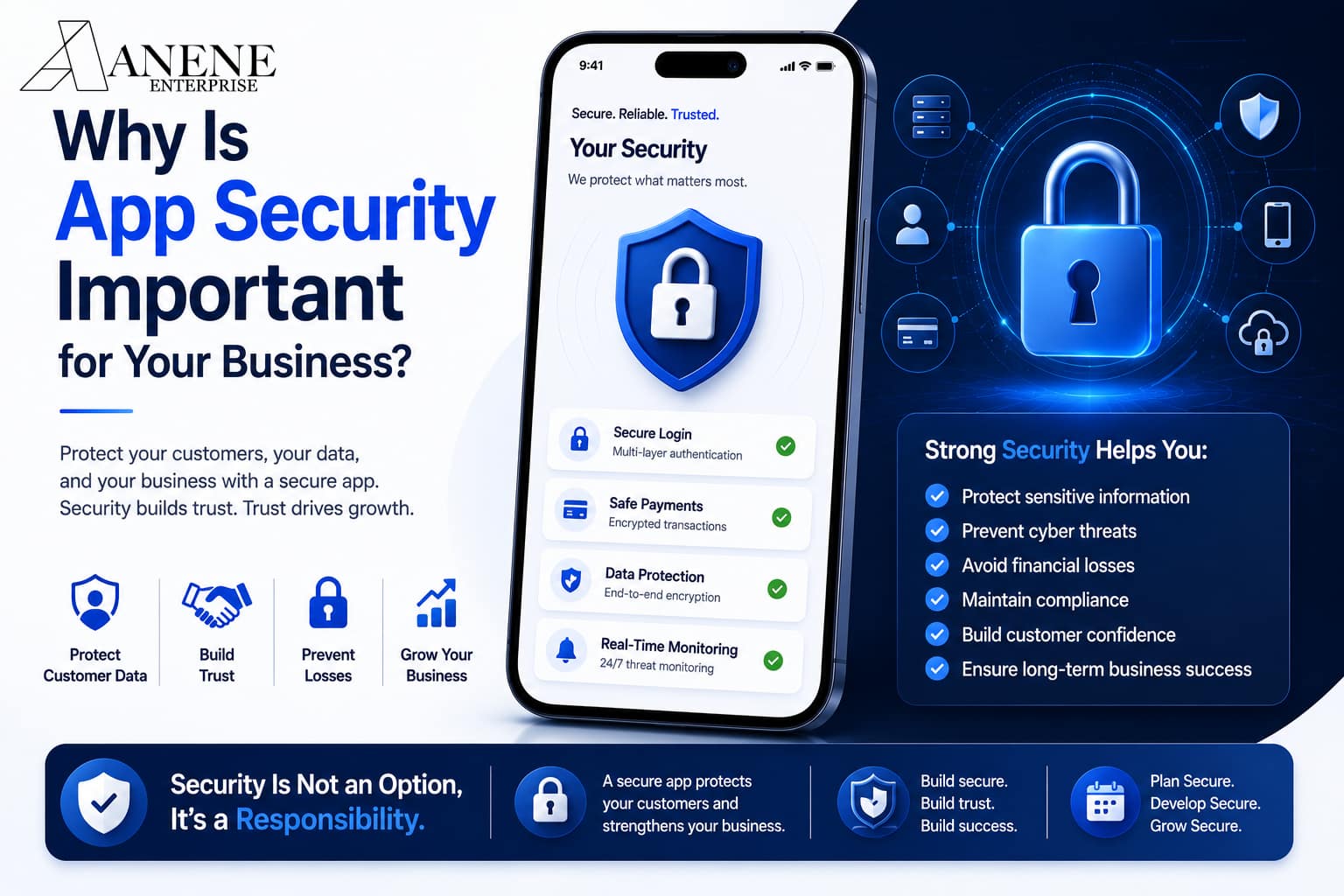
In today’s digital world, businesses depend heavily on technology to communicate with customers, manage operations, process payments, and store important information. Mobile applications have made these activities faster and more convenient, but they have also created new security responsibilities for businesses.
When customers use an application, they expect their personal information, account details, payment information, and other data to remain safe. A single security weakness can damage customer trust, create financial losses, and negatively affect a company’s reputation.
This is why app security should not be treated as an optional feature. It should be considered an essential part of building and maintaining a professional mobile application.
At Anene Enterprise, we believe security should be considered from the earliest stages of a digital project. Whether you’re developing an e-commerce application, booking platform, financial solution, healthcare app, or business management system, protecting your users and business data should always be a priority.
In this guide, we’ll explain why app security is important for businesses, what risks companies should understand, and how a secure application can protect both customers and organizations.
1. Protecting Customer Information
One of the biggest reasons businesses need strong app security is to protect customer information.
Mobile applications can collect different types of data, including:
- Names
- Email addresses
- Phone numbers
- Addresses
- Account credentials
- Purchase history
- Booking information
- Payment details
If this information is not properly protected, unauthorized individuals may gain access to sensitive data.
Customers trust businesses with their information. Protecting that information is therefore not only a technical responsibility but also a business responsibility.
A secure application uses appropriate security measures to reduce the risk of unauthorized access and data exposure.
2. Building Customer Trust
Trust is one of the most valuable assets a business can have.
Customers are more likely to use an application when they feel confident that their information is protected.
For example, when customers see secure login systems, trusted payment methods, privacy information, and reliable account protection, they are more comfortable using the application.
On the other hand, security problems can quickly destroy customer confidence.
Even if a business has excellent products or services, customers may leave if they don’t trust the company’s digital platforms.
Security therefore plays an important role in building long-term customer relationships.
3. Protecting Business Data
Businesses don’t only need to protect customer information.
They also need to protect their own data.
A mobile application may connect to internal systems containing:
- Product information
- Pricing
- Sales records
- Employee information
- Business reports
- Customer databases
- Inventory information
- Financial data
Unauthorized access to this information can create serious operational and financial problems.
Strong security controls help businesses protect valuable information and reduce unnecessary risks.
4. Preventing Financial Losses
Security incidents can become expensive.
Businesses may have to deal with:
- Lost revenue
- Refunds
- Recovery costs
- System downtime
- Legal expenses
- Customer compensation
- Reputation damage
For businesses that process online payments, security becomes even more important.
Secure payment processing and proper authentication can help reduce the possibility of fraudulent transactions and unauthorized access.
Investing in security before problems occur is often much less expensive than trying to recover from a major security incident.
5. Protecting Your Brand Reputation
A company’s reputation can take years to build but only a short time to damage.
Imagine a customer discovering that their personal information was exposed because of a security weakness in your application.
They may stop using your service and share their experience with others.
Negative reviews and social media discussions can quickly spread, making it difficult for a business to regain customer confidence.
A secure application demonstrates that your company takes customer protection seriously.
6. Secure Login and Authentication
User accounts are one of the most important areas of application security.
Businesses should consider strong authentication methods such as:
- Secure passwords
- OTP verification
- Multi-factor authentication
- Biometric authentication
- Account recovery protection
- Login activity monitoring
The right authentication system depends on the type of application and the sensitivity of the information it handles.
The goal is to make it difficult for unauthorized users to access customer accounts.
7. Secure Data Transmission
Information constantly moves between a mobile application and its servers.
For example, when a customer logs in, places an order, sends a message, or makes a payment, information is transmitted between different systems.
This communication should be properly protected.
Secure connections and encryption help reduce the risk of information being intercepted while it is being transmitted.
Businesses should therefore make secure communication a fundamental part of their application architecture.
8. Regular Security Updates
Security isn’t something you implement once and forget.
New vulnerabilities and threats can appear over time.
Operating systems change, third-party libraries receive updates, and attackers develop new techniques.
Regular maintenance can include:
- Security patches
- Dependency updates
- Bug fixes
- Server updates
- Vulnerability assessments
- Performance improvements
Keeping an application updated helps reduce unnecessary security risks.
9. Secure APIs and Backend Systems
Modern mobile applications often communicate with backend servers through APIs.
These APIs may handle:
- Customer information
- Product data
- Orders
- Payments
- Authentication
- Notifications
If APIs are poorly secured, attackers may attempt to access information they shouldn’t be able to see.
During App Development, businesses should ensure that APIs are properly authenticated, authorized, monitored, and protected against common security threats.
Security should cover both the mobile application and the systems behind it.
10. Security Should Start During Development
One of the biggest mistakes businesses make is waiting until the application is finished before thinking about security.
Security should be considered throughout the entire development lifecycle.
This includes:
- Planning
- Architecture
- Design
- Development
- Testing
- Deployment
- Maintenance
Building security into the project from the beginning is generally more effective than trying to fix major weaknesses after launch.
11. Secure User Experience Matters
Security should not make an application unnecessarily difficult to use.
Customers want protection, but they also want convenience.
This is where UI/UX Design can help create a balance between security and usability.
For example, security features should be presented clearly so users understand what is happening.
Login screens, verification steps, password recovery, permissions, and payment confirmations should all be easy to understand.
A good experience makes security feel like a natural part of using the application rather than an obstacle.
12. Protecting Your Website and Digital Ecosystem
Businesses often focus on securing their mobile application while forgetting that their website and other digital platforms are connected to the same business ecosystem.
Your website may contain customer accounts, contact forms, payment systems, or links to your application.
Professional Web Development should therefore include appropriate security practices from the beginning.
A secure website and secure application working together create a stronger digital environment for your customers.
13. Security Supports Your Marketing Efforts
Security can also indirectly support customer acquisition and retention.
People are more likely to download and use an application when they trust the company behind it.
Strong security practices can support your overall Digital Marketing strategy by strengthening brand credibility.
Businesses can communicate their commitment to privacy and security through:
- Privacy policies
- Security information
- Transparent data practices
- Secure payment messaging
- Customer education
Trust can make a significant difference when customers are deciding whether to use a digital service.
14. Compliance and Industry Requirements
Depending on your industry and location, your business may need to follow specific privacy or data protection requirements.
Industries such as healthcare, finance, e-commerce, and education may handle particularly sensitive information.
Businesses should understand which rules apply to their operations and ensure their application is designed accordingly.
Professional security planning can help organizations identify important compliance requirements before launch.
Common App Security Mistakes Businesses Should Avoid
Some common mistakes include:
- Using weak passwords
- Ignoring software updates
- Storing sensitive information insecurely
- Poor API protection
- Insufficient testing
- Giving unnecessary permissions
- Ignoring suspicious activity
- Using outdated libraries
- Failing to protect payment information
Avoiding these mistakes can significantly improve the security of your application.
Related Reading: Essential Features Every Professional Mobile App Should Have
If you’re planning to build a professional mobile application, security is only one part of the overall experience.
In our previous blog, “Essential Features Every Professional Mobile App Should Have,” we discussed the important features businesses should consider when planning a modern application.
The article covers essential areas such as secure registration, user-friendly interfaces, fast performance, push notifications, search functionality, payment integration, analytics, security, scalability, and content management.
Understanding these features alongside security requirements can help businesses create applications that are not only functional but also reliable and trustworthy.
Why Choose Anene Enterprise for Your Digital Solution?
Security requires careful planning, technical expertise, and continuous attention.
At Anene Enterprise, we understand that businesses need digital solutions that are not only visually appealing but also reliable, scalable, and secure.
Our approach focuses on understanding your business requirements before development begins. We consider the application’s users, data, integrations, performance requirements, and future growth.
From planning and design to development, testing, deployment, and maintenance, security should remain an important part of the process.
Whether you’re launching a new mobile application or improving an existing digital product, our goal is to help you create a solution that customers can use with confidence.
Final Thoughts
App security is not simply a technical requirement it is an important part of protecting your business, customers, reputation, and long-term growth.
A secure application helps protect sensitive information, reduce financial risks, build customer trust, and create a stronger digital experience.
Businesses should think about security from the beginning rather than waiting until after an application has been launched.
Strong authentication, secure data transmission, protected APIs, regular updates, proper testing, and responsible data management can all contribute to a safer application.
At Anene Enterprise, we believe that successful digital products are built on a combination of strategy, technology, usability, and security.
If your business is planning a mobile application, make security a priority from day one not an afterthought.