

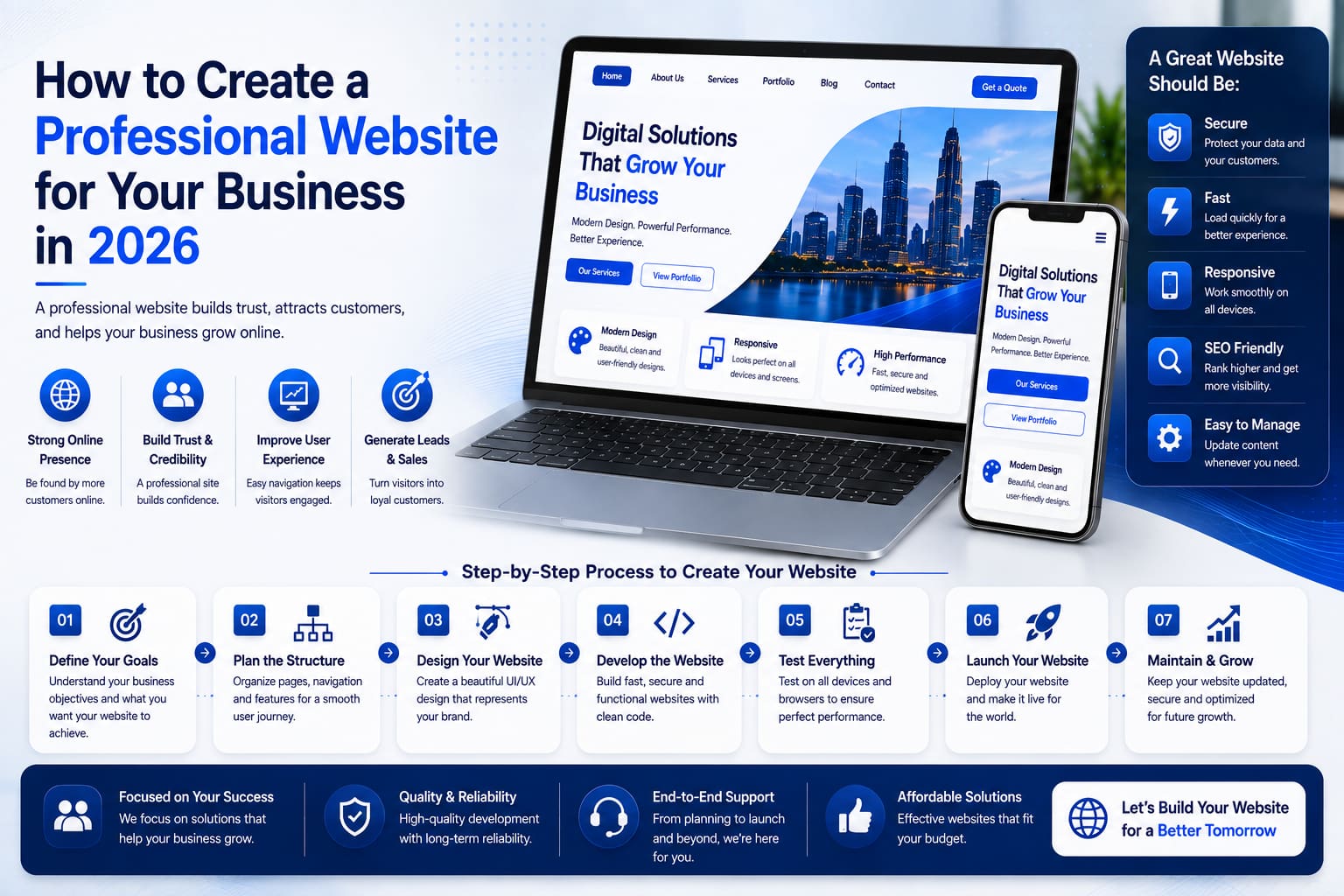
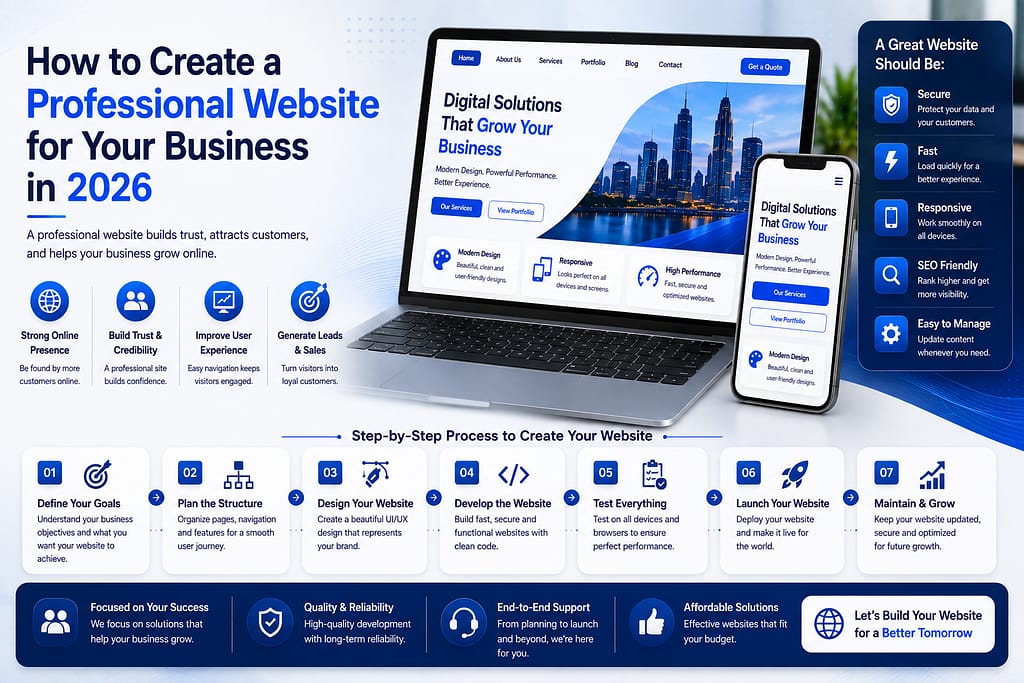
In 2026, a professional website is much more than an online page that displays your company name, services, and contact information. It has become one of the most important parts of how customers discover, evaluate, and interact with a business. Before contacting a company, many potential customers will search for it online, visit its website, explore its services, and decide whether the business looks professional and trustworthy. This means your website often creates an impression before you ever have the opportunity to speak with a customer. Anene Enterprise understands the importance of building a digital presence that represents a business professionally while also supporting its long-term goals.
Creating a professional website requires more than selecting a template and adding a few pages. A successful website needs careful planning, clear objectives, useful content, strong performance, responsive layouts, security, and an experience designed around the people who will actually use it. Businesses also need to consider how their website will continue to support them as technology and customer expectations change. If you are planning to create a new business website in 2026, understanding the complete process can help you make better decisions from the beginning.
Start With a Clear Purpose for Your Website
Before thinking about colours, layouts, images, or technical features, you should understand exactly why your business needs a website. Different businesses have different objectives, and those objectives should influence almost every decision made during the project. A local service provider may want to generate enquiries and appointments, while an online retailer may want to sell products directly to customers. A corporate company may need to establish credibility and provide detailed information about its services, whereas a startup might use its website to introduce a new idea and attract potential customers or investors.
Anene Enterprise believes that identifying the purpose of a project early makes the entire creation process more focused. Ask yourself what you want visitors to do after arriving on your website. Do you want them to call your business, request a quotation, purchase something, create an account, schedule an appointment, or simply learn more about your company? Once the primary objective is clear, the structure of the website can be developed around helping visitors reach that goal.
It is also useful to define your target audience at this stage. Understanding who will visit your website can influence everything from the tone of your content to the way information is organized. A website created for business professionals may require a very different approach from one targeting younger consumers. The clearer you are about your audience, the easier it becomes to create an experience that feels relevant to them.
Plan the Structure Before Starting Development
One of the biggest mistakes businesses make is beginning the technical work before deciding what the website actually needs. Planning the structure first can save significant time and prevent unnecessary changes later. A basic business website might include a homepage, about page, services section, portfolio, blog, contact page, and other pages depending on the company’s requirements.
A strong Web Development process begins with understanding how these pages will connect and how visitors will move between them. Navigation should be straightforward so users do not have to search excessively for important information. The most valuable pages should be accessible through clear menus, and the overall structure should make sense even to someone visiting the website for the first time.
This stage is also the right time to identify important functionality. Some businesses may require booking systems, online payments, customer accounts, quotation forms, product catalogues, live chat, dashboards, or integrations with external systems. Understanding these requirements before technical work begins allows developers to select an appropriate architecture and avoid building a platform that becomes difficult to expand later.
Create a Design That Represents Your Brand
Visitors form opinions about websites very quickly, which makes visual presentation extremely important. The design should reflect the personality and professionalism of your company while remaining easy to understand. Colours, typography, spacing, images, icons, and other visual elements should work together to create a consistent identity.
Professional UI/UX Design goes beyond making a website visually attractive. It considers how people interact with every page and how easily they can complete important actions. A visitor should be able to understand what your company offers without reading large amounts of unnecessary information. Important buttons should be easy to identify, navigation should feel natural, and the hierarchy of each page should guide attention toward the most useful content.
Consistency is equally important. If buttons look completely different across various pages or navigation changes unexpectedly, users can become confused. A consistent interface creates familiarity and makes the experience feel more polished. Businesses should therefore establish clear design patterns that can be used throughout the website rather than designing every page independently.
Focus on the User Journey
A professional website should be designed around the customer rather than around the internal structure of the company. Business owners naturally understand their own services and terminology, but visitors may be discovering the company for the first time. Information therefore needs to be presented from their perspective.
Good UI/UX Design makes the journey from arrival to action as simple as possible. Imagine someone discovers your business through a search engine and arrives on one of your service pages. The visitor should quickly understand what the service is, why it may be useful, why your company is a credible choice, and what they should do next. Every unnecessary obstacle between these stages can increase the chance that the person leaves.
Calls to action are particularly important. Buttons such as “Get a Quote,” “Book Now,” “Contact Us,” or “Learn More” should appear where they naturally support the visitor’s journey. The objective is not to place buttons everywhere, but to provide clear next steps when users are ready to continue.
Make Mobile Responsiveness a Priority
A professional website in 2026 must provide an excellent experience on mobile devices. Customers frequently discover businesses while using smartphones, which means a desktop-only approach can create serious usability problems. Text that is difficult to read, buttons that are too small, images that extend beyond the screen, and complicated navigation can quickly frustrate mobile visitors.
Modern Web Development should use responsive techniques so layouts automatically adapt to different screen sizes. This does not mean simply shrinking the desktop version. Mobile experiences often require adjustments to spacing, navigation, image sizes, content hierarchy, and interactive elements.
Testing across different devices is also important because a layout that works perfectly on one screen may behave differently on another. Businesses should evaluate important pages on smartphones, tablets, laptops, and larger desktop displays before launch. Providing a consistent experience across these devices makes the website accessible to a much wider audience.
Build for Speed and Performance
Website speed has a direct impact on the experience visitors receive. People expect pages to load quickly, especially when browsing from mobile devices. Large images, unnecessary scripts, poorly optimized code, excessive animations, and inefficient hosting can all contribute to slow performance.
Performance should be considered throughout the Web Development process rather than being addressed only after the website has been completed. Images can be optimized, unnecessary resources can be reduced, caching can be configured, and technical decisions can be made with efficiency in mind.
Fast websites feel more professional and make it easier for visitors to explore additional pages. Performance can also support search visibility because search engines consider page experience when evaluating websites. A visually impressive design provides limited value if visitors leave because they have to wait too long for the content to appear.
Create Useful and Persuasive Content
Design attracts attention, but content explains why someone should choose your business. Your website should clearly communicate what you offer, who you help, and what makes your company different. Avoid filling pages with complicated industry terminology when simpler language would communicate the message more effectively.
Anene Enterprise recommends creating content around the questions potential customers are likely to have. A service page should explain the service clearly, describe its value, and provide enough information for someone to decide whether they want to learn more. An about page should communicate the company’s story and credibility rather than simply providing generic statements.
High-quality images and visual content can also strengthen the message. Original photographs, relevant illustrations, product images, project examples, and carefully selected graphics can make pages easier to understand. However, visuals should support the content rather than distract from it.
Prepare Your Website for Search Engines
Creating a great website is only useful if potential customers can discover it. Search engine optimization should therefore be considered while the website is being planned and created rather than being added as an afterthought.
SEO begins with understanding what potential customers search for. Pages can then be structured around relevant topics while still providing genuinely useful information. Page titles, headings, URLs, internal links, image descriptions, and meta information should clearly communicate what each page contains.
Quality is particularly important in 2026. Publishing repetitive content purely to insert keywords is unlikely to create a strong experience. Search-focused content should answer real questions and provide useful information. A well-organized website with valuable content can gradually build stronger organic visibility and attract visitors who are actively looking for related services.
Connect Your Website With Your Growth Strategy
Once a website is live, businesses need ways to bring the right audience to it. Search visibility can contribute to organic traffic, while social platforms, paid campaigns, email, and other channels can help introduce the company to additional potential customers.
A well-planned Digital Marketing strategy should connect promotional activity with specific pages and objectives. For example, an advertisement for a particular service should usually direct visitors to a relevant landing page instead of sending everyone to a generic homepage. The page should continue the same message that attracted the visitor and provide an obvious next action.
Analytics can then help businesses understand what happens after people arrive. You can evaluate which channels generate useful traffic, which pages receive the most attention, and where visitors leave the customer journey. These insights can guide future improvements and make online promotion more effective over time.
Think Beyond the Website When Necessary
A website is an excellent foundation, but certain businesses may eventually need a more specialized mobile experience. Companies offering regular customer interactions, booking functionality, delivery services, memberships, marketplaces, or other recurring services may find value in providing users with a dedicated mobile product.
Professional App Development can support these requirements when a mobile product genuinely provides additional convenience. However, businesses should avoid creating an application simply because having one sounds impressive. There should be a clear reason customers would install and continue using it.
The website can often serve as the starting point for understanding customer behaviour. Once a company learns which services and features customers use most frequently, it can make better decisions about whether a dedicated mobile solution would create meaningful value.
Add Trust and Security Elements
Visitors need to feel confident when interacting with your business online. Security is particularly important when websites collect personal information, accept payments, provide user accounts, or handle other sensitive interactions.
SSL protection, secure forms, strong authentication where necessary, reliable hosting, software updates, backups, and proper technical maintenance should all be considered. Security is not something businesses should address only after a problem occurs.
Trust is also communicated visually and through content. Clear contact information, customer testimonials, case studies, policies, professional branding, and transparent information about the company can all increase credibility. Anene Enterprise considers trust an important part of the overall digital experience because customers are more likely to take action when they feel confident about the business behind the website.
Test Everything Before Launch
Launching without proper testing can turn small technical issues into frustrating customer experiences. Before making a website publicly available, every important feature should be reviewed carefully.
Forms should be submitted to confirm that messages reach the correct destination. Buttons and links should lead to the intended pages. Images should display correctly, and content should be reviewed for errors. The website should also be tested across multiple browsers and screen sizes.
Performance testing is equally valuable. Developers can identify pages or resources that are taking too long to load and optimize them before customers encounter the problem. Testing should also include the complete customer journey. If the objective is to generate enquiries, someone should test the entire process from entering the website to successfully submitting an enquiry.
Professional Web Development includes this quality-control stage because a successful launch depends on much more than whether the homepage looks correct.
Launch Is the Beginning, Not the End
A common misconception is that website creation ends when the website goes live. In reality, launch should be viewed as the beginning of the next stage. Once real visitors start interacting with the platform, businesses gain information that was not available during development.
Analytics can reveal which pages people visit most often, how long they stay, which devices they use, and how effectively they complete important actions. This information can help identify opportunities for improvement.
Digital Marketing can also provide valuable insights into audience behaviour after launch. Campaign results may reveal which services generate the most interest or which messages encourage customers to take action. Businesses can use these findings to refine both their promotional strategy and website experience.
Regular maintenance is equally important. Software should be updated, security should be monitored, backups should be maintained, and outdated information should be corrected. Businesses should periodically review their websites to ensure everything continues to represent the company accurately.
Build With Future Growth in Mind
Your business may look very different two or three years from now. You might introduce new services, enter new markets, hire more employees, serve additional locations, or change the way customers interact with your company. A website should therefore be flexible enough to evolve with the organization.
Anene Enterprise approaches digital projects with long-term scalability in mind. This does not mean businesses need to pay for every possible feature at the beginning. Instead, the technical foundation should avoid unnecessary limitations that could make future expansion difficult.
For example, a business may initially need only an informational website and enquiry form. Later, it could require customer accounts, online payments, appointment scheduling, or advanced integrations. Planning the structure carefully from the beginning can make these additions easier when the business is ready for them.
Bringing Your Professional Website to Life in 2026
Creating a professional business website in 2026 requires a balance between strategy, creativity, technology, performance, security, and customer understanding. The strongest websites are not necessarily those with the most animations or the largest number of features. They are the ones that clearly communicate the company’s value and make it easy for visitors to accomplish what they came to do.
Start by defining the purpose of your website and understanding your audience. Plan the structure before moving into design, and create an interface that represents your brand without sacrificing usability. Build the technical foundation around speed, security, responsiveness, and scalability. Once the website is live, continue learning from customer behaviour and make improvements based on real information.
Anene Enterprise helps turn business ideas into professional digital experiences built around practical goals. The right website can become much more than an online presence. It can strengthen credibility, introduce your services to new audiences, simplify customer interactions, generate opportunities, and become an important part of your company’s long-term growth.
A successful website should represent where your business is today while being ready for where you want to go next. With careful planning and the right digital expertise, your website can become one of the most valuable assets your business owns in 2026 and beyond.